Every state's fertility rate, 1992–2024
In three decades India went from 3.4 children per woman to 2.0. Only a handful of states are still above replacement level.
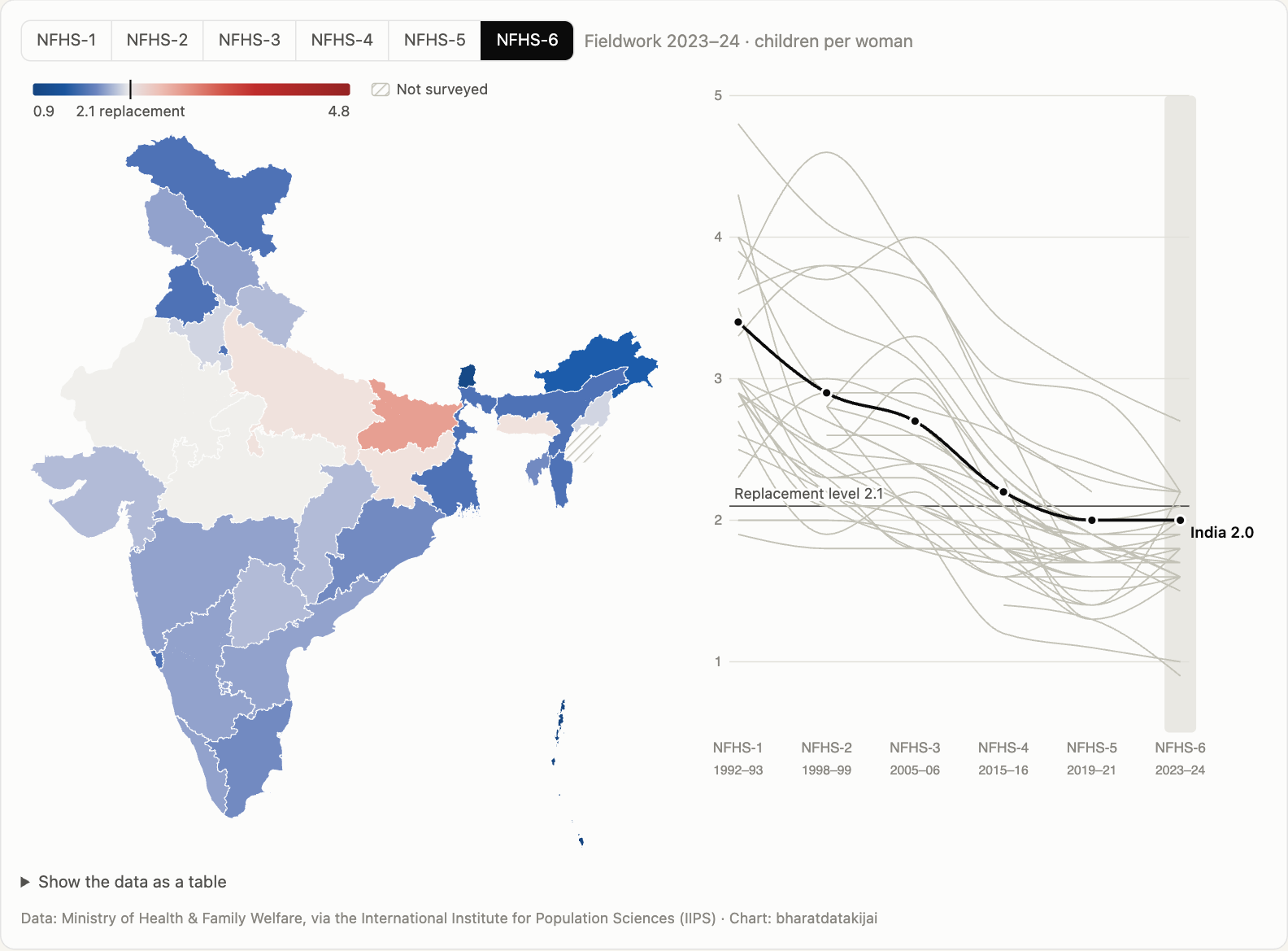
The total fertility rate is the number of children a woman would have over her lifetime at current rates. At about 2.1, a population replaces itself. India’s first National Family Health Survey, in 1992–93, measured 3.4. The latest, NFHS-6 in 2023–24, measured 2.0, the same as NFHS-5.
Blue states are below replacement and red ones above. Step through the survey rounds and the map turns blue from the south upward. Today only Bihar (2.7), Jharkhand, Lakshadweep, Meghalaya and Uttar Pradesh (2.2) are still above 2.1. Andaman & Nicobar (0.9) and Sikkim (1.0) are among the lowest in the world.
The national number stalled between the last two rounds, and 16 states and UTs ticked up in NFHS-6. It’s too early to call that a trend.
Hover over a state on the map, or over a line, to follow it through all six surveys.