Every month of GST, and where it's paid
In August 2017, India's first full month of GST brought in ₹0.96 lakh crore. In April 2026 it brought in ₹2.43 lakh crore. Maharashtra alone pays 22% of domestic GST.
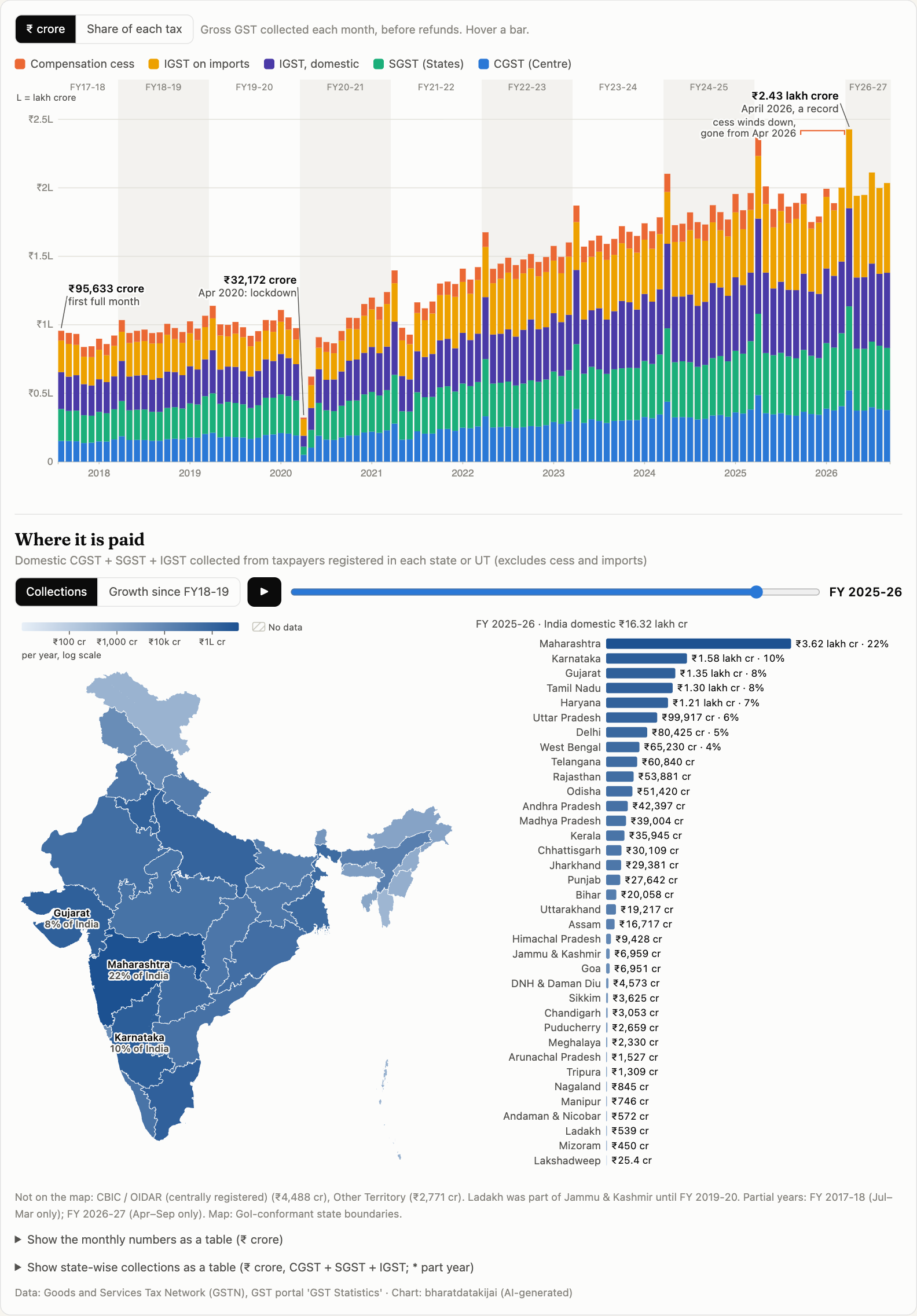
Each bar is one month of gross GST: the central tax (CGST), the state tax (SGST), integrated GST on trade between states and on imports (IGST), and the compensation cess. India’s first full GST month, August 2017, brought in ₹95,633 crore. April 2026 set the record at ₹2.43 lakh crore. Over a full year, collections went from ₹11.77 lakh crore in FY 2018-19 to ₹23.32 lakh crore in FY 2025-26.
Two things break the pattern. In April 2020, the first full month of the COVID lockdown, collections fell to ₹32,172 crore, a third of the month before. And apart from 2020, every April is higher than the months on either side, because that is when businesses pay the tax for March, the last month of the financial year. The orange cess layer, about ₹11,652 crore in September 2025, shrank to ₹103 crore by March 2026, and from April 2026 GSTN no longer reports it. Switch to share of each tax: since May 2026, IGST on imports has been 30–32% of the total each month.
The map shows where the tax is paid. Maharashtra collected ₹3.62 lakh crore of domestic GST in FY 2025-26. That is 22% of the national total and more than Karnataka and Gujarat together. The top five states pay 56% of it. Use growth since FY18-19 to see which states grew fastest. Some of the fastest growth is in small northeastern states starting from a low base.
One caveat: GST is meant to be a tax on consumption, but these figures count it where the seller is registered. IGST paid on a sale from one state to another is later settled with the state where the buyer is, so a state’s collections are not the same as the revenue it keeps.