Seventy-five harvests
India harvested 51 million tonnes of foodgrains in 1950–51 and an estimated 377 million in 2025–26. Wheat output grew nearly nineteenfold, but the land under foodgrains grew by less than half.
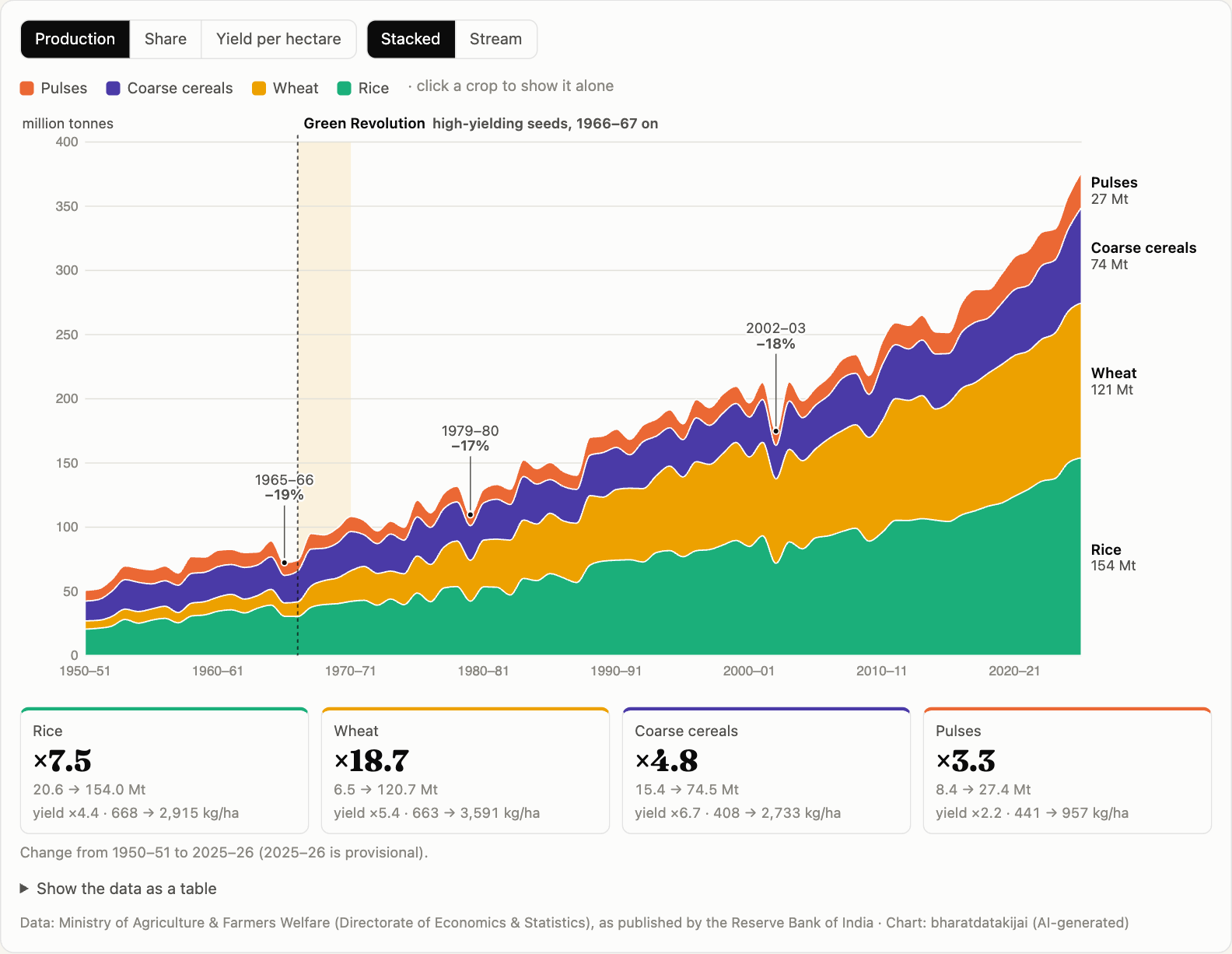
This is every Indian harvest since independence: foodgrain production by crop for each crop year from 1950–51 to 2025–26, from the Ministry of Agriculture’s estimates as published by the Reserve Bank of India.
In 1950–51 India grew 50.8 million tonnes of foodgrains. The latest estimate for 2025–26 is 376.6 million tonnes, 7.4 times as much. The land under foodgrains only grew from 97 to 142 million hectares. Nearly all of the rest came from higher yields: an average hectare gave 522 kg of grain in 1950–51 and 2,646 kg in 2025–26.
Wheat changed the most. It was 6.5 million tonnes in 1950–51, a thin strip under the other crops. Two weak harvests followed in 1965–66 (total output fell 19%) and 1966–67. Then the Green Revolution’s high-yielding seeds arrived, and wheat more than doubled in five years, from 10.4 million tonnes in 1965–66 to 23.8 million in 1970–71. It is now 120.7 million tonnes, almost a third of the harvest.
Pulses fell behind. Their output is only 3.3 times what it was in 1950–51, and their share of the harvest has dropped from 16.5% to 7.3%. Pulse yields have barely doubled, to 957 kg a hectare. Switch to yield per hectare to compare the crops, or to Stream to see the harvest as one shape.